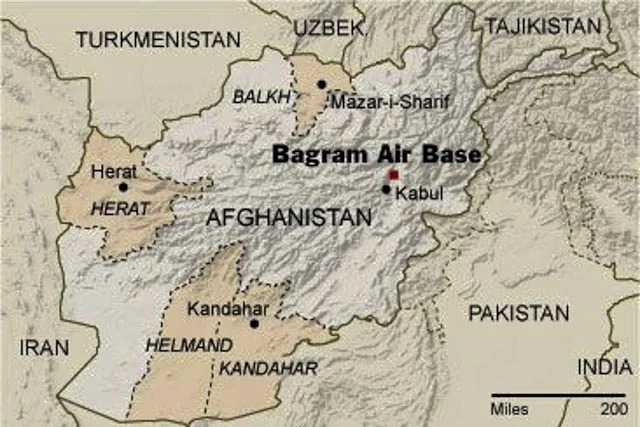
Five years after US military forces withdrew from Afghanistan , US President Donald Trump has demanded that Taliban handover the Bagram airbase over to Washington. He followed up that demand with a pointed threat on his Truth Social platform: “If Afghanistan doesn’t give Bagram Airbase back to those that built it, the United States of America, BAD THINGS ARE GOING TO HAPPEN!!!”
Trump has also referred to China as a key reason for wanting to retake control of Bagram, saying this month in London that the base is “an hour away from where [China] makes its nuclear weapons”.
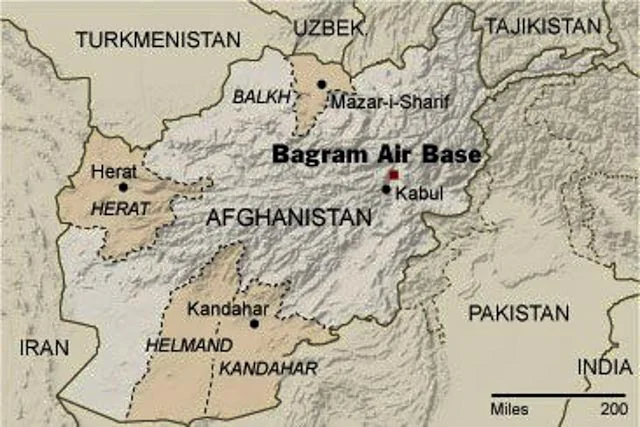
It has been a strategic stronghold for the many military powers that have controlled Afghanistan – and fought over it – over the past half-century.Bagram is about 800km (about 500 miles) from the Chinese border, and about 2,000kms(about 1,200 miles) from Lop Nur nuclear test site.
Bagram is not just an airstrip; it is a strategic crown jewel. Its value extends far beyond monitoring China’s Lop Nur facility. Control of Bagram would provide the United States with a platform to project power and maintain surveillance over challengers(say China , Russia, Iran) and allies( Pakistan) alike.This move is not an isolated demand but appears to be a key component of a broader Middle Eastern and Asian policy designed to manage an entire region from a single, powerful hub.
This integrated regional approach is underscored by a significant diplomatic shift. The planned appointment of Sergio Gor not just as the Ambassador to India, but simultaneously as the Special Envoy for South and Central Asian Affairs demonstrates that it is definintely not a bluff and the U.S. now views India not through a siloed, special relationship, but as a critical pillar within a wider “China-containment” strategy spanning the entire region. A re-established Bagram, operating under CENTCOM, would serve to secure the western flank. In this framework, India is a crucial maritime partner in the Indo-Pacific, while Bagram would be the continental dagger, ensuring stability and U.S. influence on India’s volatile western frontier.
It points towards the possibility of the Trump administration being open to the idea of engagement with the Taliban, as evident in other examples of the US president showing a willingness to build ties with leaders that Washington has previously treated as enemies: from Ahmed al-Sharaa in Syria to Vladimir Putin in Russia and Kim Jong Un in North Korea.This doctrine of ‘Engaging with adversaries’ is precisely what makes a Bagram deal conceivable.The path forward can be through a grand bargain, , offering the Taliban what it needs i.e.full diplomatic recognition and the unlocking of frozen assets in exchange for a long-term lease on the air base.
While Washington has maintained a policy of non-recognition, Russia has formally removed the Taliban from its terrorist list and deepened ties, and China has granted de facto recognition.Beijing’s engagement is particularly strategic. It has secured a 25-year contract to extract oil from the Amu Darya basin and is actively working to integrate Afghanistan into its BRI, potentially through an extension of the China-Pakistan Economic Corridor (CPEC). In return, the Taliban has assured China it will not host Uyghur militant groups, securing Beijing’s sensitive Xinjiang border.
The U.S., by staying on the sidelines, is risking ceding all influence in Afghanistan to its competitors, getting the cost of isolation without any of the strategic benefits.
For India, which has cautiously engaged with the Taliban while condemning its human rights record, this shifting landscape presents a complex challenge. However, a U.S. deal that legitimizes the Taliban regime in exchange for the base would force India to navigate a diplomatic tightrope between USA and Taliban regime.
“Bagram Gambit” is not just a bluff, It’s about the US trying to get back in the game in a region where its rivals are already winning, using a combination of a tough threat and a potential deal.
No responses yet